
Village of Harris
R.M. of Harris No. 316

Village of Harris Bylaws
Bylaws
BYLAW # 121-2012
A BYLAW TO CONTROL ANIMALS IN THE VILLAGE OF HARRIS
The Council of the Village of Harris in the Province of Saskatchewan enacts as follows:
1. This Bylaw shall be known as the “Animal Control Bylaw”.
2. DEFINITIONS
In this Bylaw the following definitions apply:
a. Animal Control Agency or Animal Control Officer – means the Animal Control Agency/Officer appointed by the Village of Harris.
b. Bylaw Enforcement Officer – means the person or persons appointed or contracted by the council of the Village of Harris for the purpose of enforcing the provision of this bylaw.
c. Municipality or Village – means the Village of Harris.
d. Council – means the council of the Village of Harris.
e. Clerk – means the administrator of the Village of Harris.
f. Cat – means a male or female cat or a male or female kitten over (8) weeks of age.
g. Dog – means a male or female dog or a male or female puppy over twelve (12) weeks of age.
h. Dangerous Animal – means
i) any animal, that without provocation in a vicious or menacing manner, chases or approaches a person or domestic animal in an apparent attitude of attack;
ii) any animal with a known propensity, tendency or disposition to attack without provocation, to cause injury or to otherwise threaten the safety of persons or domestic animals;
iii) any animal that, without provocation has bitten, inflicted injury, assaulted or otherwise attacked a person or domestic animal;
iv) any animal which is owned primarily or in part for the purpose of animal fighting or is trained for fighting.
v) Any dog that has been trained as a guard dog where such training involves physical attack on an intruder when such animal is not engaged in guarding a business premise or residence.
vi) any animal declared dangerous under Division 5 of The Municipalities
Act, S.S. 2005, c. M-36.1.
i. Judge – means a judge of the Provincial Court of Saskatchewan or a justice of the peace.
j. Court – means the Provincial Court of Saskatchewan established pursuant to The Provincial Court Act.
k. Owner – includes:
i) a person, persons, partnership, association or corporation who keeps, possesses, harbors or has care of or control of a dog or cat;
ii) the person responsible for the custody of a minor where the minor is the owner of a dog or cat.
l. Person – means and includes an individual(s), partnership, association or corporation.
m. Pound – means such premises and facilities as may be designated by the Council of the Village of Harris for the purpose of safely lodging and securing animals seized pursuant to this bylaw.
n. Pound keeper – means a person designated by the Village of Harris from time to time to maintain and administer the pound.
o. Provocation – means an act done intentionally for the purpose of provoking an animal to which this Bylaw applies.
p. Running at Large – means when the dog or cat is beyond the boundaries of the land occupied by the owner, possessor or harborer or keeper of the said dog or cat, or beyond the boundaries of any lands where it may be with the permission of the owner or occupant of the said land and is not under control by being:
i) on a leash or harness and in direct and continuous charge of a person competent to control it; or
ii) securely confined within an enclosure; or
iii) securely fastened so that it cannot roam at will.
q. Working Guide Dog – means any dog whose primary purpose is to guide and provide assistance to individuals who are visually, physically or hearing impaired and who have successfully completed a recognized training program for use as a service dog.
3. REGISTERING
a. Every owner of a dog within the Village shall cause each such animal to be registered with the Village office. At the time of registering, the applicant shall complete an Application for Registration of a Dog as set in Appendix “E”, and provide the Village office with a physical description of the animal, the breed of the animal which will be accompanied by a photograph of the animal, a rabies certificate valid for the registration year, and the name, address and telephone number of the owner of the animal. A record of the license, name and address of the owner will be kept at the Village office.
b. License Fees shall become due on January 1st of each year or at any time during the year immediately upon a person becoming an owner of a dog, and failure to do so shall constitute an offence under this Bylaw.
c. The registration year for dogs shall be from the first day of January to the thirty-first day of December of the same year.
d. Every owner of a dog shall no later than February fifteenth in each year register the said dog at the village office and failure to do so shall constitute an offence under this bylaw.
e. In addition to the registration requirements laid down in Section 3(a) (b) (c), the owner of a dog shall pay an annual registration fee as set out in Schedule “A” attached hereto and which may be amended from time to time by resolution of council.
f. In addition to the registration requirements laid down in Section 3(a) (b) (c),
the owner of a dog deemed “dangerous” shall pay an annual registration fee
as set out in Schedule “A” attached hereto and which may be amended from
time to time by resolution of council.
g. The sum payable for a registration fee required after the thirty-first day of July in a calendar year shall be calculated at a prorated amount of months left in the calendar year and shall expire on the thirty-first day of December in the same calendar year.
h. Any dog registration certificate or applicable fee issued pursuant to the provisions of this bylaw by the Village shall not be transferable to any other dog or cat.
i. Notwithstanding Section 3(e), a dog which has been professionally trained as a Working Guide Dog as defined in Section 2(q) shall be subject to an annual registration fee as set out in Schedule “A” attached hereto and which may be amended from time to time by resolution of council.
j. The provisions of this section shall not apply to the dogs kept, in the ordinary course of business by the proprietors of the following premises as licensed by the Village of Harris:
i) a veterinary hospital, clinic, boarding kennel or grooming parlor;
ii) a public pound;
iii) a shop whose business includes the sale of pets;
iv) a shelter operated by an association or society incorporated for the purpose of the protection and humane treatment of animals.
k. A person residing in the Village who owns, possesses keeps or harbors a dog and neglects or refuses to register or pay any applicable registration fee shall be subject to the penalties as outlined in Schedule “C” of this bylaw.
l. The owner shall be supplied with a current registration tag and a receipt for payment of the registration fee when the dog is registered. The registration tag must be renewed each year. The owner will be issued a replacement registration tag if the current registration tag is lost or destroyed and the owner shall be responsible for the replacement cost, as set out in Schedule “D”.
m. The owner of or dog shall ensure that the dog wears a collar to which is attached a valid license tag whenever the dog is off the premises of the owner.
n. This Section shall not apply while a dog is participating in a recognized dog show, obedience trial or field trial, or where an electronic identification microchip has been implanted in the animal and the identification information related to the microchip has been provided to the Village.
o. Any owner of an animal within the Village of Harris who has not registered their animal(s) with the Village of Harris prior to this bylaw coming into effect will be required to register the dog within 60 days of this bylaw coming into effect and failure to do so shall constitute an offence under this bylaw.
p. No person shall:
i) Untie, loosen or otherwise free a dog or cat which has been tied or restrained; or
ii) Negligently or wilfully open a gate, door or other opening in a fence or enclosure in which a dog or cat has been confined and thereby allow a dog or cat to run at large in the Village of Harris;
iii) Tease, entice, bait or throw objects at a dog or cat confined within its owner’s property.
iv) Register or attempt to register a female as a male dog.
q. The owner of a currently licensed dog shall notify the village in the event that a dog is deceased and will therefore be removed from the village records.
4. LIMITED NUMBER OF ANIMALS
No person shall keep, possess or harbour more than two (2) dogs or two (2) puppies which are over the age of twelve (12) weeks and/or two (2) cats that are over the age of eight (8) weeks and any person who does is deemed to have failed or refused to comply with the provisions of this section and shall be subject to the penalties as outlined in Schedule “C” of this Bylaw. Any persons already in ownership of animals exceeding the limit prior to this bylaw coming into effect will be required to register and license all animals. At the time when one of these exceeding limit animals becomes deceased or is removed from the property owners, renters or lease holders possession by whatever means for a term exceeding 60 days no replacement animal will be allowed.
5. RUNNING AT LARGE
The owner of a dog or cat shall not at any time allow the dog to run at large within the Village, except in designated areas.
a. When a dog or cat is found to be running at large, its owner is deemed to have failed or refused to comply with the provisions of this section.
b. Where a dog or cat is found to be running at large, the owner or occupant of that property on which the dog or cat is running at large may make a written complaint to the Bylaw Enforcement Officer.
6. SEIZURE AND IMPOUNDING
a. A Bylaw Enforcement Officer or Peace Officer may seize and impound any dog or cat observed to be at large or creating a nuisance.
b. A Bylaw Enforcement Officer or Peace Officer may enter onto land surrounding any building in pursuit of any dog or cat, which has been observed to be at large or creating a nuisance.
c. The Bylaw Enforcement Officer is hereby authorized to seize and capture, by the use of a tranquilizer gun or other methods authorized by resolution of Council and impound any dog or cat running at large or creating a nuisance contrary to the provisions of this bylaw.
d. Any person may take any dog or cat found running at large or creating a nuisance contrary to the provisions of this bylaw to the Village pound.
e. No person, whether or not he is the owner of a dog or cat which is being or has been pursued or seized shall:
i) interfere with or attempt to obstruct a Bylaw Enforcement Officer who is attempting to seize or has seized any dog or cat in accordance with the provisions of this bylaw;
ii) unlock or unlatch or otherwise open the vehicle in which dogs or cats seized under this bylaw have been placed so as to allow or attempt to allow any dog or cat to escape there from.
iii) remove or attempt to remove any dog or cat from the possession of the Bylaw Enforcement Officer.
f. In the event that the animal in question can not be caught by the Animal Control Officer, he is authorized to take a photograph of the animal and, upon establishing the owner of the animal, a fine will be levied against the owner. The same fine structure will apply to picture fines as other fines.
g. Upon receipt of a completed and signed complaint, the Village Administrator shall notify the owner, possessor or harbourer by registered mail that a complaint has been received and that, in the event of failure to pay the appropriate voluntary fine relevant to the infraction within seven (7) days of the receipt of the notice, the Village Administrator shall take the steps necessary to prosecute the owner, possessor or harbourer. The complaint shall be in the form attached hereto and marked as Appendix “E” and forming part of this bylaw.
7. POUND
a. The council shall endeavor to appoint a poundkeeper.
b. All dogs and cats impounded in the pound shall be so confined therein for a period of 72 hours from the time of capture during which time the owner thereof shall have the right to repossess the said dog or cat upon paying to the village office the amount set forth in Schedule “B” to this bylaw as amended from time to time by resolution of council.
c. No dog or cat, which is impounded, shall be released to its owner or to any other person until the appropriate pound fee is paid until it has been registered.
d. When a dog or cat has been impounded, the Village office shall immediately attempt to contact the owner as shown in the records made when the animal was registered at the address shown therein, that unless the said animal is claimed and the fees as provided for in this bylaw are paid within 72 hours from the date of the impounding the said animal shall be dealt with pursuant to the provisions of the bylaw.
e. All impounded dogs or cats which are not claimed within 72 hours as aforesaid, may be sold by the Village office to any person paying for such dog or cat, a sum equal to any amount owing to the Village due to applicable fines, registration or impound fees and, for the cost of registering as provided for by this bylaw. In the event any dog or cat is not sold after expiration of the said 72 hours, it shall be disposed of in the most humane way possible.
f. It shall be the duty of the poundkeeper to provide each dog or cat impounded under the authority of this bylaw an adequate supply of food and fresh water during its confinement in the pound.
g. Any dog or cat found in any public street, lane, park, boulevard or other public place or otherwise running at large contrary to the provisions of this bylaw, the Bylaw Enforcement Officer or Peace Officer may seize and impound by the use of a tranquilizer gun or other methods authorized by Council.
8. LITTER – DOGS AND CATS
a. If a dog or cat defecates on any public or private property other than the property of the owner, possessor or harborer of the said dog or cat, the owner, possessor or harborer of the dog or cat shall cause such defecation to be removed immediately and disposed of in a sanitary fashion. Failure to cause such removal shall be an infraction of this bylaw.
b. Defecation’s deposited on the private property of the owner, possessor or harborer of a dog or cat shall be removed and disposed of in a sanitary manner.
c. An Animal Protection Officer or Bylaw Enforcement Officer may serve an owner or occupant of private property with a notice to remove all animal feces from the property within 72 hours of service of the notice.
d. If a notice under Section 7(d) is not served personally on an owner or occupant of private property, then a copy of the notice shall be sent by registered mail to the owner of the property at the mailing address shown on the last revised assessment roll of the town.
e. A notice served by registered mail is deemed to have been received on the fifth day following the date of its mailing.
f. The Village may remove the feces from the property if:
i) The person to whom the request is made fails to remove the feces within 72 hours; or
ii) After reasonable inquiry, the whereabouts of the owner or occupant of the property cannot be determined.
g. If the Village carries out the work under Section 7(f), the costs and expenses incurred are a debt due to the Village and the Village may recover the costs and expenses:
i) by action in a court of competent jurisdiction;
ii) in the same manner as municipal taxes; or
iii) by adding the costs and expenses to and thereby they form part of, the taxes on the land on which the work was done.
9. NUISANCE
a. The owner, possessor or harborer of a dog or cat shall not allow the animal to create a nuisance to any person by excessive barking, howling, hissing, or otherwise making disruptive noises; attempting to bite or biting anyone or any domestic animal, chasing vehicles or bicycles; causing damage to any property; urinating, defecating or spraying on or otherwise damaging or interfering with any property other than the property of the owner, possessor, or harborer; and any owner, possessor or harborer who contravenes this section commits an offence under this bylaw.
b. Any owner of a dog or cat who fails to immediately restrain and remove the animal upon it becoming a nuisance is guilty of an offence, and in such event, an Animal Protection Officer, Poundkeeper or Bylaw Enforcement Officer may seize and impound the animal.
10. RABIES AND OTHER DISEASES
a. Any dog or cat suspected of having rabies shall not be killed but shall be secured and isolated for seven (7) days and the matter immediately reported to a veterinary clinic whose instructions shall be complied with.
b. An owner possessor or harborer of a dog or cat who neglects or refuses to comply with any order of the veterinary clinic shall be guilty of an infraction of this bylaw.
11. DANGEROUS ANIMAL
a. Dangerous Animals are defined at Section 2(h).
b. Exemption for Guard Dogs
i) No dog shall be considered dangerous where an action described in Section 2(h) occurred while the dog was:
(A) acting in the performance of police work; or
(B) working as a guard dog on commercial or residential property;
(C) securely enclosed on property by a fence or other barrier sufficient to prevent the escape of the dog and the entry of children of tender years; and
(D) defending that property against a person who was committing an offence.
c. Dangerous Animal Hearings
i) If a complaint is made that an animal is dangerous, the sitting council shall take into consideration the circumstances for the complaint and determine if, based upon the evidence submitted, that the animal is, in fact, dangerous.
ii) Notice of the complaint received by the village referred to in Section 11(c)(i) shall be served upon the owner of the animal. The notice shall be served:
(A) in the case of an owner who is an individual:
(1) by delivering it personally to the owner; or
(2) if the owner cannot conveniently be found by leaving it for the owner at the owner’s residence with a person at that residence who appears to be at least 18 years of age; or
(3) by sending it by ‘Registered Mail’ to address registered on the tax roll or utility.
(B) in the case of an owner that is a corporation:
(1) by sending it by ‘Registered Mail’ to the registered office of the corporation; or
(2) By delivering it personally to the manager, secretary or other executive officer of the corporation or the person in charge of any office or other place where the corporation carries on business in Saskatchewan.
iii) Any dispute of the decision of council declaring a dog “dangerous”,
shall be determined by a judge.
iv) Where an owner does not appear at the time and place appointed for the hearing after having been notified of that time or place, the judge may proceed ex parte to hear and determine the proceedings in the absence of the owner as fully and effectively as if the owner had appeared.
v) If the judge is satisfied, on the evidence, that the animal is dangerous, the judge shall make an order embodying all of the following terms:
(A) if the owner removes the animal from the owner’s property, the owner shall muzzle and leash it in accordance with the criteria prescribed in Section 16 and keep it under direct control and supervision;
(B) the owner shall inoculate the animal against rabies in accordance with the provisions of Section 17;
(C) the owner shall report the sale or other disposition of the animal to a designated officer appointed pursuant to Section 22;
(D) where the animal is moved to a different Town or municipality, the owner shall notify the clerk of that Town or municipality;
(E) where the animal is to be sold or given away, the owner shall:
(1) notify any prospective owner that the animal has been declared dangerous, before it is sold or given away; and
(2) notify a designated officer appointed pursuant to Section 22 of the name, address and telephone number of any new owner of the animal;
(F) if the animal is not registered as dangerous, the owner shall, at the owner’s expense and within ten days of the date of the order, purchase the requisite registration for the animal;
vi) An order pursuant to Section 11(c)(iv) may also include any or all of the following terms:
(A) the owner shall keep the animal in an enclosure which complies with the criteria prescribed in Section 18;
(B) within 10 days of the date of the order, the owner shall obtain and keep in effect liability insurance in an amount of not less that $500,000.00 for any bodily injury to or death of any person or domestic animal, or for damage to property, caused by the animal and provide copy to the Village office;
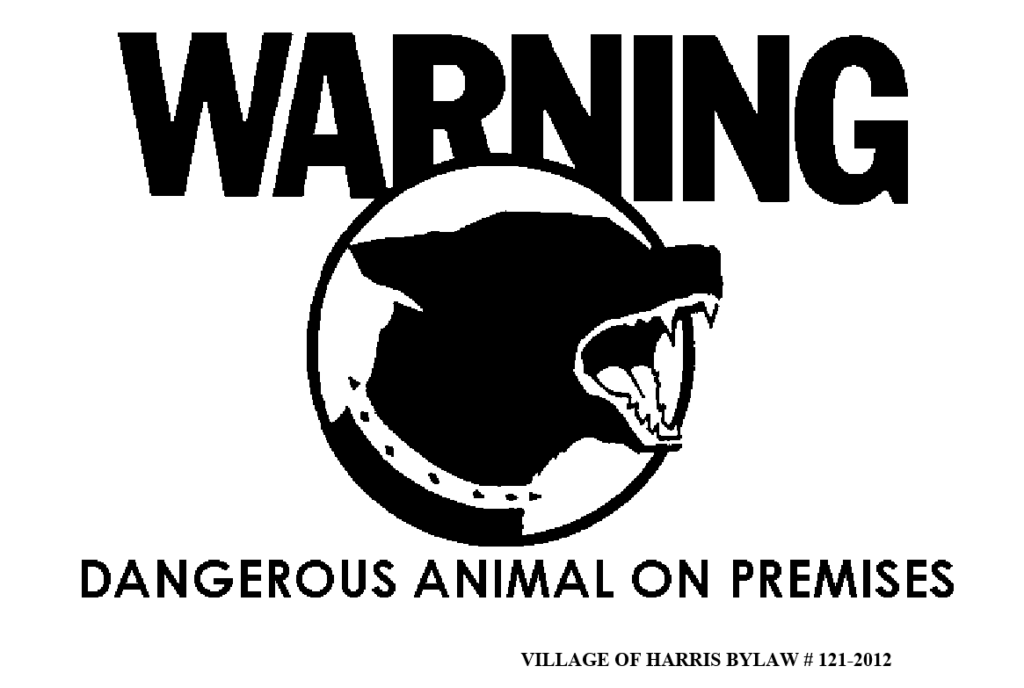
(C) the owner shall display a sign, which complies with the criteria prescribed in Section 19, on the owner’s property warning of the presence of the animal and shall continue to display that sign in good condition so long as the animal is present on the property;
(D) the owner shall have the animal spayed or neutered;
(E) the owner shall take such other measures as the judge considers appropriate.
vii) Notwithstanding Section 11(c)(vii) a judge may in the alternative, order that the animal be destroyed or otherwise disposed of at the owner’s expense and shall give directions with respect to the destruction or other disposition.
viii) Where an order has been made pursuant to Section 11(c)(vi) against the owner, the owner may apply to the judge who made the order for an order that compliance with the provisions of Section 11(c)(vi)(B) be waived.
ix) Application pursuant to Section 11(c)(viii), the judge may waive compliance with Section 11(c)(vi)(B), on any terms and conditions that the judge considers reasonable, where the judge is satisfied that
the owner is unable to comply with the requirements of that clause for a reason other than the owner’s financial circumstances.
x) A person desiring to appeal an order pursuant to this Section shall, within seven days of the order being appealed from, file a notice of appeal with Her Majesty’s Court of Queen’s Bench, and the provisions of Part XXVII of the Criminal Code apply with any necessary modification.
d. Offences and Penalties
i) Any person who owns a dog for the purpose of dog fighting, or trains, torments, badgers, baits, or otherwise uses a dog for the purpose of causing or encouraging the dog to make unprovoked attacks on persons or domestic animals is guilty of an offence.
ii) Any person who displays a prescribed sign warning of the presence of a dangerous animal and who is not acting in accordance with an order made pursuant to Section 11(c)(vi) or has not received the permission of the Village to display the sign is guilty of an offence.
iii) Any person who does not comply with any part of an order made against him or her pursuant to Section 11c (iv), (v), or (vi), is guilty of an offence.
iv) Any person who owns an animal that, without provocation, attacks, assaults, wounds, bites, injures or kills a person or domestic animal, is guilty of an offence.
v) A person who is guilty of an offence pursuant to this Section is liable on summary conviction:
(A) in the case of an individual, to a fine not exceeding $10,000.00, or imprisonment for not more than six months, or both;
(B) in the case of a corporation, to a fine not exceeding $25,000.00, or imprisonment of the directors of the corporation for not more than one year, or both.
vi) In addition to imposing the penalty under Section 11(c)(v), the convicting judge shall make an order embodying the requirements of Section 11(c) (iv).
vii) An order pursuant to Section 11(c)(vi) may also include the requirements of Section 11(c)(v).
viii) Notwithstanding Section 11(c)(vii), the judge may, in the alternative, order that the animal be destroyed or otherwise disposed of at the owner’s expense and shall give directions with respect to the destruction or other disposition.
ix) A person desiring to appeal an order or conviction pursuant to this Section shall, within seven days of the order or conviction being appealed from, file a notice of Appeal with the Court, and the provisions of Part XXVII of the Criminal Code apply with any necessary modification.
e. Order Binds Subsequent Owner
i) An order issued pursuant to Section 11(c) or (d) continues to apply if the animal is sold or given to a new owner or is moved to a different municipality.
f. Execution of Destruction Order
i) Unless the owner otherwise agrees, every order for destruction of an animal shall state that it shall not be implemented for eight days.
ii) Where an appeal is taken against an order for the destruction of an animal, the application of the order is stayed pending the disposition of the appeal.
(iii) Regardless of the outcome of the appeal, the owner shall be responsible for the payment of the costs of impoundment of the animal pending the hearing.
g. Return of Animal
i) Where the judge on appeal overturns the order for destruction of the animal, the animal shall be released to the owner after the owner has paid the costs of impoundment of the animal pending the hearing.
12. DANGEROUS DOG
a. Requirements for maintaining a Registration for a dangerous dog are as follows:
i) An owner of a Dangerous Dog shall maintain in force a policy of liability insurance providing third party liability coverage in a minimum amount of $500,000.00 for injuries caused by the owner’s restricted dog. The owner shall provide a photocopy of the said liability insurance policy to the village office when applying for a dangerous dog registration. The liability policy shall contain a provision requiring the insurer to immediately notify the Village in writing in the event the policy expires, is cancelled or is terminated. Upon cancellation, expiry or termination of the liability insurance policy, the dangerous dog license is null or void;
ii) At all times while a dangerous dog is on the premises of its owner, the owner shall either keep such dog confined indoors under the effective control of a person over the age of eighteen (18) years, or confined in an enclosure which complies with the criteria prescribed in Section 18:
iii) When any dangerous dog is off the premises of the owner, the owner shall muzzle and leash it in accordance with the criteria prescribed in Section 16 and keep it under direct control and supervision;
iv) The owner shall display a sign, which complies with the criteria prescribed in Section 19, on the owner’s property warning of the presence of the animal and shall continue to display that sign in good condition so long as the animal is present on the property;
v) The owner shall inoculate the animal against rabies in accordance with the provisions of Section 17;
vi) If the animal has been previously registered without the “dangerous dog” designation, the owner shall, at the owner’s expense and within ten days of being deemed a dangerous dog, purchase the requisite registration for the animal
13. DESTRUCTION BY PEACE OFFICERS
a. A peace officer as defined by the Criminal Code may destroy any animal that the officer find injuring or viciously attacking a person or domestic animal.
b. Where the officer acted in good faith, a peace officer who destroys an animal pursuant to subsection a. is not liable to the owner for the value of the animal.
14. ENTRY AND SEARCH
a. If a peace officer as defined by the Criminal Code or a designated officer has reasonable grounds to believe that an animal that is dangerous or has been ordered to be destroyed or otherwise disposed of is in or on any premises, the peace officer or designated officer may enter the premises and search for and impound the animal in accordance with Section 378(1) of The Municipalities Act, and as amended from time to time by the Act:
378(1) A peace officer or a designated officer who has reasonable grounds for believing that an animal is dangerous or has been ordered to be destroyed or otherwise disposed of and is in or on any premises other than a private dwelling may, with or without a warrant:
(a) enter the premises;
(b) search for the animal; and
(c) either impound the animal or, if there is an order to destroy or otherwise dispose of the animal, deliver the animal to the person appointed in the order to destroy or otherwise dispose of it.(2) notwithstanding subsection (1), a peace officer or designated officer shall not enter any place that is a private dwelling without:
(a) the consent of the owner or occupant of the private dwelling; or
(b) a warrant issued pursuant to subsection (3) authorizing the entry.(3) if it appears to a justice of the peace or provincial court judge that, based on evidence presented by a peace officer or designated officer under oath, there are reasonable grounds to believe that an animal that is dangerous or has been ordered to be destroyed or otherwise disposed of is in a private dwelling, the justice of the peace or provincial court judge may issue a warrant authorizing a peace officer or designated officer to enter the private dwelling specified in the warrant and search for the animal.
(4) On issuance of a warrant pursuant to subsection (3), the peace officer or designated officer may:
(a) enter the private dwelling;
(b) search for the animal; and
(c) either impound the animal or, if there is an order to destroy or otherwise dispose of the animal, deliver the animal to the person appointed in the order to destroy or otherwise dispose of it.
15. CHARGES MAY BE ADDED TO PROPERTY TAXES
a. If a person owes the Village for costs incurred by the Village with respect to a dangerous animal, the Village may add the amount owing to the tax roll of any parcel of land for which the person is the assessed person.
b. If an amount is added to the tax roll of a parcel of land pursuant to Section 14(a), the amount:
i) is deemed for all purposes to be a tax imposed pursuant to section 369 of The Municipalities Act from the date it was added to the tax roll; and
ii) forms a lien against the parcel of land in favour of the Village from the date it was added to the tax roll.
16. CRITERIA FOR MUZZLE AND LEASH FOR DANGEROUS ANIMALS
a. Where an animal that has been declared dangerous pursuant to Section 11(c) is removed from the owner’s property, the animal shall be equipped with a muzzle and be secured by a leash in accordance with the following criteria:
i) the animal shall be fitted with a collar or harness for the body that is properly placed and fitted on the animal;
ii) the movement of the animal shall be controlled by a person by means of a leash attached to the collar or harness of the animal;
iii) the leash shall not exceed 1.2 metres in length and shall be constructed of a material having a tensile strength of at least 40 kilograms;
iv) the muzzle on the animal shall be properly fitted on the animal to prevent it from biting any animal or person;
v) the muzzle shall be fitted on the animal in a manner that it will not interfere with the vision or respiration of the animal.
17. INOCULATION OF DANGEROUS ANIMALS
a. Where an animal has been declared to be dangerous pursuant to Section 11(c), the owner of the animal shall, at the owner’s expense and within ten days of registering the animal, have the animal inoculated against rabies by a veterinarian and provide proof to a designated officer that the dog has been inoculated within 10 days.
b. Where the owner of an animal provides proof that the animal has been inoculated against rabies during the period of 12 months prior to the date of the order, the owner is not required to comply with Section 16(a) until the expiration of 12 months from the date of inoculations of the animal.
18. ENCLOSURES FOR DANGEROUS ANIMALS
a. If the animal is a dangerous animal or if a judge orders pursuant to Section 11(c) (vi)(A) that an animal be kept in an enclosure, the enclosure must comply with the following criteria:
i) the enclosure shall be substantially constructed of wood or any other building material to adequately contain the animal and prevent escape from the property. Any escape will prove that it is not adequate for the containment of the animal and measures shall be taken to prevent any further incidences of escape.
ii) confine the animal; and
iii) prevent the entry of children of tender years;
iv) the entrances and other areas by which entry to or exit from the enclosure may be made shall be locked or fastened in a manner adequate to prevent the animal from escaping from the enclosure;
19. SIGNS FOR DANGEROUS ANIMALS
a. Where an animal has been declared dangerous pursuant to Section 11 (c), the owner of the animal shall, within ten days of registering animal, display a sign on his or her premises warning of the presence of the animal in the form illustrated in Appendix “B”.
b. A sign required by Section 19(a) shall be placed at each entrance to the premises where the animal is kept and on the enclosure in which the animal is confined.
c. A sign required by Section 19(a) shall be clearly visible and capable of being read from any adjacent public road.
20. QUARANTINE OF ANIMALS
a. Where an animal has bitten a person or domestic animal, the owner of the animal shall, unless the animals is ordered destroyed, quarantine the animal for observation for symptoms of rabies for a period of not less than ten days in accordance with the Animal Disease and Protection Act (Canada).
21. RABIES TEST OF ANIMALS
a. Every person who destroys an animal following the non-fatal biting of a person or domestic animal, whether the destruction is pursuant to an order of a judge or court or at the decision of the owner of the animal, shall, if the destruction is carried out before the completion of the quarantine period mentioned in Section 20, retain the head of the animal in a manner usable for testing the animal for rabies.
b. Where a person destroys an animal in the circumstances described in Section 21(a), the person shall immediately notify a veterinarian or a peace officer that he or she is in possession of the head of an animal to be tested for rabies.
22. APPOINTMENT OF DESIGNATED OFFICERS
a. The Bylaw Enforcement Officer, Pound Keeper and/or the Animal Control Officer shall be designated officers for the purposes of this Bylaw.
b. The Bylaws Enforcement Officer, Pound Keeper and the Animal Control Officer are authorized to delegate enforcement of this Bylaw to their employees.
23. OWNING AND HARBORING EXOTIC AND WILD ANIMALS
a. No person shall own or harbor any animal, or hybrid of any animal, of the kind listed in Appendix “C” for any purpose.
b. No person, partnership or corporation, whether operated separately or in connection with another business enterprise, shall operate a pet store that buys, sells, trades, exhibits or harbors any animal or hybrid of any animal of the kind listed in Appendix “C”.
24. GENERAL PENALTY
a. A person who contravenes any provision of this bylaw or neglects or refuses to comply therewith shall be guilty of an offence and liable upon summary conviction to a fine of not less than $50.00 and:
i) in the case of an individual, to a fine not exceeding $10,000.00, or imprisonment for not more than six months or both;
ii) in the case of a corporation, to a fine not exceeding $25,000.00, or imprisonment of the directors of the corporation for not more than one year, or both.
25. LIVESTOCK AND POULTRY
a. For purposes of this section, the following definitions shall apply:
i) livestock – means any domestic animal usually raised for sale and profit, including but not necessarily limited to:
(1) an animal as defined in Section 2(b) of The Stray Animal Act; or
(2) an animal as defined in sections 2 & 3 of The Stray Animals Regulations, 1999.
ii) poultry – means:
(1) domestic fowl usually propagated and fattened for the table and for their eggs, feathers, etc., including but not limited to chickens, geese, ducks, turkeys, guinea fowl;
OR
(2) pigeons of the species Columa Livia, commonly known as the domestic pigeon and includes pigeons raised for the purpose of racing, show, table and pets and includes feral pigeons.
b. No person shall possess, harbor, confine, herd, graze or allow grazing of any livestock or poultry within the limits of the Village.
i) Section 25(b) shall not apply to livestock and poultry brought in to the Village for the duration of a special event at which the said livestock and poultry will be used for purposes of exhibition or performing at a special event.
ii) Section 25 (b) shall not apply to livestock and poultry housed at the following properties:
Parcel A, Section 13-32-12-3, Sup 0 (Skelton)
Lot PT, Block 20, Plan G734, Sup 01 (Nelson);
COT, Title # 101566997EE (Hansen);
COT, block A, Plan 101567112 (Castiday).
At the time of the passing of this bylaw, livestock currently housed at
Lots 3 & 4, Block 19, Plan 62S04497 (Roberts)
shall remain, but any future owners of this property will need permission from the council.
26. PENALTY
a. Where any person has committed or is alleged to have committed a breach of any of the provisions of this bylaw, a ticket in the form designated Appendix “A” attached to and forming part of this bylaw may be served on such person by the Bylaw Enforcement Officer of designated Village employee.
b. A person to whom a ticket is being issued pursuant to this section shall furnish the Bylaw Enforcement Officer or designated Village employee with his/her name and address upon request.
c. Notwithstanding Section 15, a person who contravenes any provision of this bylaw upon being served with a ticket may voluntarily pay the prescribed penalty as set forth in Schedule “C” to this bylaw as amended from time to time by resolution of Council.
d. If the Village receives voluntary payment of the prescribed penalty within seven (7) days from the date the ticket was issued, the person receiving the ticket shall not be liable for prosecution for the offence.
e. If the person who has committed or is alleged to have committed a breach of any section of this bylaw fails to pay the specified fine within the time allowed following service of the ticket, the provisions of this section no longer apply and the person shall be liable to prosecution for the offence.
27. REPEAL
a. Bylaw #120-2011 passed December 7, 2011, being a bylaw to control Animals in the Village of Harris, is hereby repealed.
28. SEVERABILITY
a. A decision of the Court that one or more of the provisions of this bylaw are invalid in whole or in part does not affect the validity, effectiveness or enforceability of the other provisions or parts thereof with respect to this bylaw.
29. EFFECTIVE DATE
a. This bylaw shall come into force and take effect on the date of the final reading thereof.
____________________________
Mayor
(SEAL)
____________________________
Administrator
Passed by resolution of council August 16th, 2012
Certified a true copy of Bylaw #121-2012
___________________________ Mayor
___________________________Administrator
BYLAW # 121-2012 Schedules and Appendices
SCHEDULE “A”
Annual Registration Fee for Non-Restricted Sterilized Dogs (Section 3)
$10.00 per dog per year
Annual Registration Fee for Non-Restricted Non-Sterilized Dogs (Section 3)
$20.00 per dog per year
Annual Registration Fee for Dogs deemed Dangerous (Section 3)
$200.00 per dog per year
Annual Registration Fee for Working Guide Dog (Section 3)
$0 per dog per year
SCHEDULE “B”
Section 7 Dog or Cat Pound Fees
Impoundment:
| First offence | $25.00 plus $10.00 per day or part thereof |
| Subsequent offences | $50.00 plus $10.00 per day or part thereof |
| Care and Sustenance Fee | $10.00 per day or a portion thereof commencing at 12:00 AM on the day immediately following the day of impoundment. |
SCHEDULE “C”
| OFFENCE | PENALTIES | ||
| 1st Offence | 2nd Offence | Subsequent Offences | |
| 1. Running at Large (Sec. 5) | $100.00 | $200.00 | $400.00 |
| 2. Unlicensed Animal (Sec. 3) | $100.00 | $200.00 | $400.00 |
| 3. Animal Not Wearing License (Sec. 3) | $100.00 | $200.00 | $400.00 |
| 4. Exceeding Number of Animals (Sec. 4) | $100.00 | $200.00 | $400.00 |
| 5. Dog/Cat Creating a Nuisance (Sec. 9) | $100.00 | $200.00 | $400.00 |
| 6. Failure to Remove Defecation (Sec. 8) | $50.00 | $100.00 | $200.00 |
| 7. Accumulation of Animal Feces (Sec. 8) | $50.00 | $100.00 | $200.00 |
| 8. Interference with Enforcement (Sec. 6) | $100.00 | $200.00 | $400.00 |
| 9. Untie or free an animal (Sec. 3) | $50.00 | $100.00 | $200.00 |
| 10. Willfully open gate or door to allow escape (Sec. 3) | $50.00 | $100.00 | $200.00 |
| 11. Tease, throw things at cat or dog (Sec. 3) | $50.00 | $100.00 | $200.00 |
| 12. Interfere or obstruct Bylaw Enforcement Officer (Sec. 6) | $100.00 | $200.00 | $400.00 |
| 13. Exotic/Wild Animals (Sec. 23) | $50.00 | $100.00 | $200.00 |
Reduce penalty by 25% if paid within 7 days of issuance.
| OFFENCE – DANGEROUS DOGS | PENALTIES | |
| 1st Offence | Subsequent Offences | |
| 1. Failure to obtain and keep in force registration (Sec 3) | $250.00 | $500.00 |
| 2. Failure to maintain a policy of liability insurance (Sec.11) | $250.00 | $500.00 |
| 3. Failure to confine in proper enclosure when on owner possessor or harborer’s premises (Sec. 11) | $250.00 | $500.00 |
| 4. Failure to muzzle and harness or leash when off premises of owner, possessor or harborer (Sec 11) | $250.00 | $500.00 |
| 5. Failure to prevent from running at large (Sec 12) | $250.00 | $500.00 |
SCHEDULE “D”
Replacement Tags $5.00
Appendix “A”
Appendix “B”
Appendix “C”
Being a list of animals the keeping of which is prohibited within the Village of Harris:
– All Arachnids dangerous to humans (such as scorpions and tarantulas, except tarantulas of the genera Aphonopelma, Avicularia and Grammostola)
– All Artiodactylus Ungulates, except domestic goats, sheep and cattle
– All Bats
– All Canids, except the domestic dog
– All Crocodilians (such as alligators, crocodiles and caimans)
– All Edentates (such as anteaters, sloths and armadillos)
– All Elephants
– All Felids, except the domestic cat
– All Hyaenas
– All Marsupials (such as kangaroos and opossums)
– All Mustelids (such as skunks, weasels, otters and badgers) except the domestic ferret
– All non-human Primates (such as gorillas and monkeys)
– All Perissodactylus Ungulates, except the domestic horse, mule and ass
– All Pinnipeds (such as seals, fur seals and walruses)
– All Procyonids (such as raccoons, coatis and cacomistles)
– All Raptors, diurnal and nocturnal (such as eagles, hawks and owls)
– All Ratite Birds (such as ostriches, rheas, and cassowaries)
– All snakes of the families Pythonidae and Boidae
– All Ursids (bears);
– All venomous Reptiles and Amphibians;
– All Viverrids (such as mongooses, civets and genets);
Examples of animals of a particular prohibited group are given in parentheses. They are examples only and shall not be construed as limiting the generality of the group.
Appendix “D”